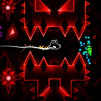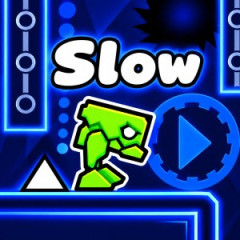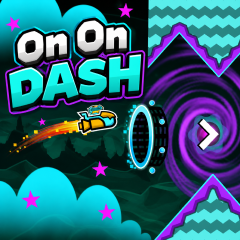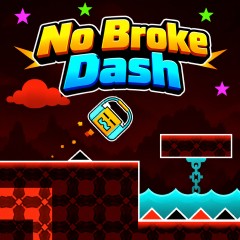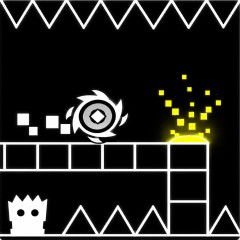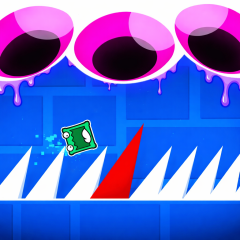
Challenge Rush brings together fast movement, rhythmic gameplay, and precision platforming in an arcade experience that rewards players who can react at exactly the right moment. Your character automatically travels forward through a series of obstacle filled courses, leaving you to concentrate on when to jump, fly, or change direction. A single mistimed action can end an otherwise promising run, so maintaining focus is essential from the first obstacle to the finish line.
What makes the gameplay particularly interesting is the variety of movement forms. You will encounter the Cube, Ball, UFO, Ship, and Wave, each introducing a different way to navigate the environment. Some sections require quick jumps over sharp hazards, while others demand controlled movement through tight spaces. Portals add further surprises by changing the character's abilities and movement conditions without interrupting the pace.
The music gives each stage its own energy and can help players develop a better sense of timing. Whether you prefer taking on the full challenge or learning difficult passages at your own pace, the available Normal and Practice modes provide different ways to approach the courses.

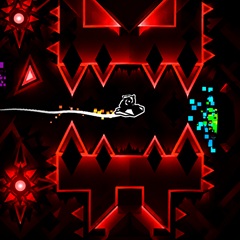
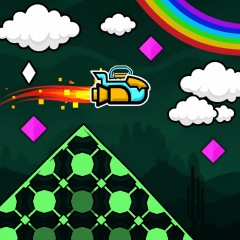
Arrow character moves through obstacles
Challenge Rush keeps its controls straightforward, allowing players to concentrate on the obstacles ahead instead of remembering complicated commands. You only need a few inputs to control the active character:
Left Mouse Button: Click to perform the main action, such as jumping or changing the character's movement.
Up Arrow: Activate the same action using your keyboard.
Spacebar: Provides another convenient way to control the character.
Although the inputs are simple, their effects depend on the current movement form. A Cube needs carefully timed jumps, whereas a Ship responds to how long you hold the button. Learning these differences is important, especially when portals introduce a new form in the middle of a challenging section.
The courses in Challenge Rush are filled with hazards that test both reaction speed and movement accuracy. Spikes punish poorly timed jumps, while gaps require players to judge distances before committing to an action. Some obstacles appear in groups, creating sequences where one successful movement must lead directly into another.
Narrow passages make these moments even more demanding because there is very little room to correct a mistake. Rather than reacting at the last second, try to observe the arrangement of upcoming hazards and prepare your next move in advance.
Portals bring unexpected changes to otherwise familiar gameplay. Passing through one can alter gravity, movement speed, or the character's current form, forcing you to adjust your approach almost immediately. A section that previously required ordinary jumping might suddenly involve flying or navigating with a completely different movement pattern.
These transitions are particularly challenging when several mechanics appear close together. Paying attention to visual changes and preparing for the next action will help you avoid losing control during important moments.
The Cube, Ball, UFO, Ship, and Wave give Challenge Rush much of its gameplay variety. Each form has its own movement behavior, meaning that a strategy that works in one section may not be useful in another.
The Cube focuses on precise jumps, while the Ball revolves around changing gravity to move between surfaces. The UFO uses repeated upward movements, and the Ship requires careful adjustments to maintain a safe flight path. Meanwhile, the Wave follows a diagonal movement pattern that makes tight corridors especially difficult.
Learning how each form responds to your input will make transitions less intimidating and help you approach complicated obstacle combinations with greater confidence.
The soundtrack adds more than atmosphere to Challenge Rush. Its rhythm can help you recognize recurring patterns and develop a better sense of when certain movements should happen. During your first attempts, pay attention to how the music aligns with jumps, portals, and changes in the course.
You do not need to depend entirely on the beat, but combining audio cues with visual awareness can make your reactions more consistent. Over time, familiar patterns become easier to recognize, allowing you to prepare for obstacles before they reach your character.
One of the most useful ways to improve is to become comfortable with all five character forms. Instead of treating every section as another jumping challenge, consider what the active form can do and how its movement differs from the previous one.
Practice controlling flight with the Ship, switching gravity with the Ball, and maintaining a suitable direction with the Wave. Once you understand these mechanics, sudden transformations become easier to manage and require fewer uncertain reactions.
Normal Mode puts your consistency to the test because mistakes can force you to restart a complete run. When a particular obstacle sequence repeatedly causes trouble, Practice Mode offers a useful opportunity to study it more carefully.
Place checkpoints before unfamiliar sections and repeat the movements until you can complete them reliably. Pay attention to the timing of each input rather than trying to rush through the course. After becoming comfortable with the difficult passages, return to Normal Mode and attempt to complete the entire stage without interruptions.
If you enjoy games that combine rhythmic action with demanding platforming, Geometry Vibes offers another exciting experience where precise jumps and well timed movements are essential for reaching the end of each level.
Challenge Rush turns a simple control system into a demanding test of concentration, timing, and adaptability. Its constantly moving character keeps the action flowing, while different movement forms and unexpected portal transitions prevent the courses from feeling repetitive. The soundtrack adds another layer to the experience, encouraging players to recognize patterns and coordinate their actions with the pace of each stage.
The balance between Normal and Practice modes also gives players room to improve without removing the challenge of completing a full run. Every failed attempt provides another chance to understand an obstacle, refine a movement, and get a little closer to the finish line. For fans of rhythm based platformers and reflex driven arcade games, Challenge Rush offers an enjoyable challenge that makes every successful run feel rewarding.